
22-24 June 2026 - Summer school on the use of AI for the analysis of extreme events
The summer school is organised within the SCEWERO project (GA 101159497). Coordinated by the University of Antwerp and organised together with Babes-Bolyai University and Euro-Mediterranean Centre on Climate Change for students and young researchers in Romania and other widening countries. The summer school will be organised as an in-person event and will be hosted by the Babes-Bolyai University in Cluj-Napoca, Romania.
The Summer School on AI Use for Climate Extremes aims to provide participants with a solid and applied understanding of how artificial intelligence and machine learning techniques can be used to analyse, detect, and forecast extreme weather and climate events. The program focuses on bridging fundamental concepts—such as machine learning algorithms and climate extreme definitions—with advanced applications, including heatwaves, intense precipitation, cyclones, droughts, and compound events.
A key objective is to equip participants with both theoretical knowledge and practical skills needed to work with climate data and AI-based models, while also addressing critical aspects such as model interpretability, uncertainty, and ethical considerations in climate science. By the end of the training, participants are expected to better understand how AI can support improved prediction, risk assessment, and decision-making processes in the context of increasing climate variability and extremes.
The program is structured over three days, progressively moving from foundational concepts to advanced applications.
It begins with an introduction to machine learning and climate extremes, followed by focused sessions on specific hazards such as heatwaves and extreme precipitation. These sessions combine theoretical lectures with applied perspectives on forecasting and model development.
The second day expands the scope to additional extreme phenomena, including cyclones and severe weather, while introducing AI-based detection and prediction tools. It also addresses complex processes such as droughts and compound events, alongside a dedicated session on ethics in AI for climate science.
The final day emphasizes advanced analytical techniques, including AI applications for drought and compound events, as well as downscaling approaches to improve the spatial resolution of climate models. The program concludes with cutting-edge methods such as high-resolution AI-based downscaling and a closing discussion, ensuring a comprehensive overview from core concepts to state-of-the-art applications.
Hands-on activities will complement sessions. For detailed information, please check the Summer School program.
During each day, poster sessions will be organised during coffee breaks, and participants can present their previous activity related to summer school topics.
- Climate, hydrology, and computer sciences students (Post-doctoral, PhD) and young researchers (less than 10 years from your PhD graduation) in Europe according to the Horizon Europe regulation.
- See minimum recommended background to attend
- We aim at 20 participants
- Affiliation in widening countries could be an advantage.
- The working language during the summer school will be English.
- The schools will be organized on 22-24 June 2026
- Registration deadline: April 30, 2026.
- Participants’ notification on acceptance and grant allocation: May 11, 2026.
- Confirmation of participation and sending required documents: May 18, 2026.
- basic concepts in machine learning and data analysis,
- data processing and visualization,
- Python programming
The venue of the summer school is Babeș-Bolyai University, Faculty of Geography, Cluj-Napoca, Romania.

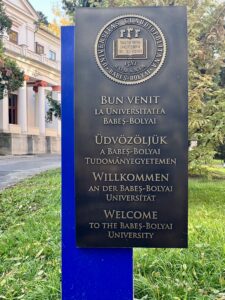


The organisers will cover lunches and coffee breaks on all days. Participants should cover travel, accommodation and other related costs.
For doctoral and post-doctoral students from widening countries in South-Eastern Europe, 15 grants will be awarded to cover accommodation and travel costs. Accommodation will be made in the Babeș-Bolyai University hostel with direct payment by the organisers in shared rooms (2-3 persons in a room). The travel grant is up to 350 EUR, and payment will be made on a cost-reimbursement basis, after the event.

Contact info
Day 1 – Foundations: Machine Learning, Climate Extremes & Heatwaves
~ A smooth introduction to machine learning algorithms
Fundamental machine learning models for regression and classification tasks
~ Introduction to Climate Extremes: Models and Data
Climate extremes, their representation in state-of-the-art models, and data availability for analysis.
~ An Introduction to Heatwaves
Definitions, drivers & impacts of extreme temperatures
~ Forecasting Heatwaves
Forecasting on seasonal timescales with dynamical and AI-driven models
~ AI-based forecasts of HW: driver selection, verification and explainability
How to optimize the setup of an AI-based forecasts for a robust scientific interpretation
Day 2 – Intense Precipitation, Cyclones & Severe Weather
~ Extreme precipitation, intro weather & seasonal prediction
Understanding precipitation estimates across various modelling approaches and perspectives
~ Data-driven forecast of intense precipitation
Locally tailored drivers and data-driven models for seasonal forecasting of intense precipitation in Europe
~ Severe weather through hail probability
Extreme precipitation contextualised as severe weather events and described by AI probabilistic models.
~ Cyclones: from the Tropics to the Mediterranean
An introduction to cyclones in different regions and their dynamic drivers.
~ AI tools for cyclone detection and prediction
How to use AI/ML tools to improve the predictive skill for extreme events, with a focus on seasonal predictions
Day 3 – Droughts, Compound Events, Downscaling & Ethics
~ An Introduction to Droughts and Compound Events
Definitions, types of droughts, and an overview of compound events and their classifications
~ Ethics in AI for Climate Science
Ethics in the use of AI in climate research and decision-making
~ AI for Drought Events
Utilizing parametric and non-parametric indices to sharpen drought detection
~ AI for Compound Events
Implementing dimension reduction techniques to identify extreme hazard events
~ Downscaling applications to enhance the accuracy of Global Climate Models
Encompassing the advantages and disadvantages of the two downscaling approaches: dynamic and statistical
~ Statistical downscaling using machine learning techniques
Bridging global seasonal forecast knowledge with local decision-making processes
~ AI for continental-scale super high-resolution downscaling
Applying convolutional neural networks and statistical learning methods to transform coarse global projections into km-resolution data at continental scales.